
Four Percent: My Daughter Joins the Filipino Nurses Who Hold Up Two Countries
Four Percent: My Daughter Joins the Filipino Nurses Who Hold Up Two Countries
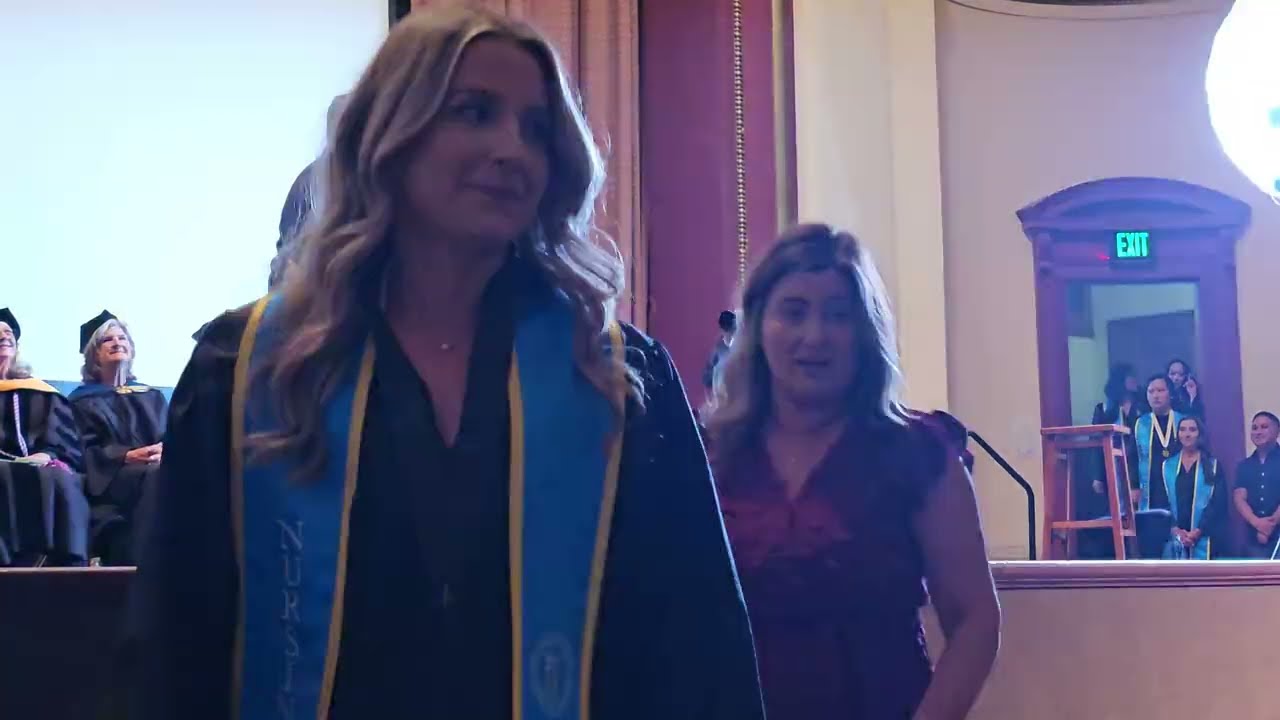
At the Dominican University of California pinning ceremony, I walked up and fastened the pin myself. Twenty-seven seconds of video, and everything underneath it.
 mAR
mAR
The speaker at the podium reads the name, and then she reads the second half of the sentence — the part that says who is doing the pinning. That is the line I had been waiting on. Not her name. The one after it.
To be pinned by her father.
I had a camera in my hand because I always have a camera in my hand, and I was standing at stage level because that is where they put the person who is going to do the pinning. So the video you are about to watch is shaky, badly framed, and shot by a man who was not, at that moment, thinking about composition.
Florence Nightingale did not write the Nightingale Pledge. It was composed in 1893 by Lystra Gretter and a committee of nurse educators at the Farrand Training School in Detroit, and named in Nightingale's honor. It is a United States custom — nurses outside the U.S. do not recite it.
💬 Please comment below ↓
Malasakit — mah-lah-SAH-kit
Concern for another person that you carry as if the burden were your own. Not sympathy, which watches from outside. Malasakit steps in. It is the closest thing our language has to a job description for a nurse — and it is why so many of our people end up doing this work.
Twenty-Seven Seconds
Here is the clip. Stage level, next to the podium, the auditorium packed behind her.
Video: PinoyBuilt / J.F.R. Perseveranda. Dominican University of California nursing pinning ceremony, San Rafael, March 15, 2026.
She does not walk across that stage. She bounds. Twenty-one years of watching her enter rooms and I still was not ready for the particular way she took those eight steps — like the gown was slowing her down and she resented it.
Then the pin. Left side, over the heart. My hands were not steady. Hers were.
What the Pin Is, and Where It Came From
A pinning ceremony is not graduation. Commencement is the university's event — cap, gown, diploma, the whole institution congratulating itself. Pinning belongs to the profession. It is smaller, older, and considerably more emotional, and its central gesture is that the graduate chooses who fastens the pin. Some choose a mentor. Some choose the nurse in the family who came first. Some choose a parent.
The ceremony usually closes with a pledge, and here is a piece of history that most people in that auditorium did not know. The Nightingale Pledge was not written by Florence Nightingale. It was written in 1893 by Lystra Gretter and a committee of nurse educators at the Farrand Training School for Nurses in Detroit, modeled loosely on the Hippocratic Oath and named for Nightingale as a tribute. It is also purely American — the rest of the nursing world never adopted it.
What interests me more is what has happened to it since. Many U.S. nursing schools now recite revised versions, and the most common revision is the removal of the line pledging loyalty to the physician. That edit is small on the page and enormous in meaning. A profession that once wrote obedience into its own oath has spent a century writing it back out, and replacing it with a duty owed directly to the patient.
Four Percent
Now the number in the headline.
Filipinos make up roughly four percent of registered nurses in the United States. That figure comes from National Nurses United, the largest nurses' union in the country, and on its own it sounds like a footnote.
Then the pandemic came, and the union started counting. In its February 2021 tally of registered nurses who had died of COVID-19 and related complications, 83 of the 314 nurses for whom race and ethnicity data existed were Filipino. Twenty-six point four percent. Four percent of the workforce, more than a quarter of the dead.
That is not a coincidence and it is not bad luck. It is a description of where our people work — bedside, acute care, night shift, the intensive care units and the nursing homes, the jobs closest to the patient and furthest from the administrative floor. Proximity to the sick is the whole profession. In 2020 it was also the risk.
My wife Tess died on December 29, 2020, of COVID, before the vaccines reached people like her. She was not a nurse. She was one of the people that year took, in the same season it was taking them, and she is the reason I know exactly what those NNU numbers describe. Five years and eleven weeks later I stood on a stage in San Rafael and pinned our youngest daughter into the profession that carried the worst of it. Tess should have been the one holding the pin. I did the best I could with the four seconds.
The Full Ceremony
The complete recording runs twenty-seven minutes. Class after class of graduates crossing, each one pinned by whoever they chose — parents, siblings, a spouse, in one case an alumna of the same program. It is worth watching all the way through even if you know no one in it, because the pattern is the point. Almost nobody chose a stranger. Almost everybody chose family.
Video: PinoyBuilt / J.F.R. Perseveranda. Full ceremony, 26:58. Dominican University of California, San Rafael, March 15, 2026.
I am not naming the other graduates or the faculty in this piece. They were on a stage, not in a press release, and this is our family's record of the day, not theirs. Their names are in the video where they said them, and that is enough.
About the program
Dominican University of California is a private university in San Rafael, twelve miles north of San Francisco, founded in 1890 by the Dominican Sisters of San Rafael — one of the oldest universities in the state. Its motto is Veritas Fax Ardens: truth is a flaming torch. The mascot is a penguin, which I have decided not to interrogate.
The Bachelor of Science in Nursing runs six semesters. Graduates finish with more than a thousand clinical and lab hours behind them, and the baccalaureate program is approved by the California Board of Registered Nursing. What comes next is the NCLEX, then licensure, then the first job, which in this profession is the year that actually teaches you the job.
What I Would Tell the Next Family
If you are a Fil-Am parent with a kid in a nursing program right now, three things.
The first is that you will be asked, at some point, whether she is doing this because Filipinos do this. Answer it honestly. There is a real pipeline behind our numbers — a century of American colonial nursing schools in the Philippines, decades of active recruitment, families in which the first person to leave was a nurse and everyone else followed the visa. That history is true, and it does not diminish a single individual choice made inside it. Chesca picked this. The history explains why the door was open. It does not explain why she walked through.
The second is to ask her, well before the ceremony, who she wants doing the pinning. Do not assume it is you. That question is hers, it is one of the first genuinely professional decisions she gets to make, and the answer means more when it was never automatic.
The third is to record it. Badly, if necessary. My clip is twenty-seven seconds of unsteady vertical footage and it is now among the most valuable files I own.
Someday a grandchild of mine is going to find this page. She will see a young woman crossing a stage in San Rafael, and a man off to the side who cannot hold the phone level. I want her to know what the pin meant, what the four percent cost, and who was missing from the room. And I want her to know that the woman on the stage went ahead and did it anyway.
Congratulations, anak.
- National Nurses United — "Sins of Omission" report and February 2021 update on COVID-19 deaths among registered nurses (nationalnursesunited.org)
- CNN — "For generations, Filipino nurses have been on America's front lines" (October 2021)
- Dominican University of California — Bachelor of Science in Nursing program information (dominican.edu)
- California Board of Registered Nursing — approved baccalaureate nursing programs
- American Nurses Association / Vanderbilt University School of Nursing — history of the Nightingale Pledge, Lystra E. Gretter and the Farrand Training School for Nurses, 1893
- PinoyBuilt YouTube — pinning ceremony recordings, March 15, 2026
Help Us Become the #1 Filipino-American Media Platform in the U.S.
PinoyBuilt is built by the community, for the community. If this article meant something to you — if it made you proud, informed, or connected — we need your help to reach every kababayan out there.
💬 Drop a comment below — tell us who pinned the nurse in your family, or who you would have chosen.
📲 Text this article to a friend, a tita, a teammate — anyone with a nurse in the house.
📣 Share it on your socials — every share brings us closer.
4.6 million Filipinos in the U.S. One platform telling our stories. Salamat, kababayan.

J.F. (Jonjo) left the Philippines at age nine, spending a lifetime bridging the gap between his Marikina roots and his Chicago/Vallejo upbringing. A proud Hogan Spartan from East Vallejo and resident of LA/SF, he founded PinoyBuilt not just as a digital archive, but as a cultural compass for his three children to navigate their heritage, language, and identity with Pinoy Pride.
Please comment below ↓


Comments
Post a Comment
Hi! Thank you for dropping by. Please leave us a comment. Sige na!